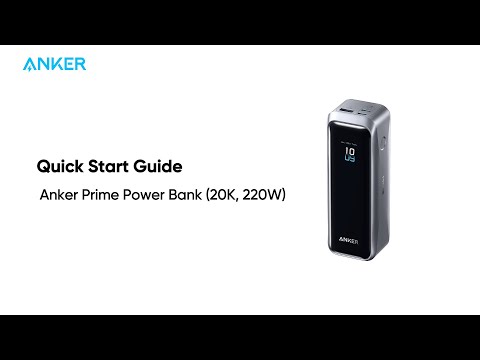
Many people wonder why a 20,000mAh power bank only charges a phone a few times. Is the advertised capacity misleading? The short answer is no. The confusion comes from how battery capacity is measured and displayed.
mAh ≠ Actual Energy
The mAh (milliampere-hour) value printed on a power bank represents charge capacity, not actual usable energy. The true measure of energy is watt-hours (Wh), which is calculated as:
Wh = (mAh ÷ 1,000) × Voltage (Cell Nominal Voltage)
Most lithium-ion power banks use cells with a nominal voltage of 3.7V.
For a 20,000mAh power bank:
20,000 ÷ 1.000 × 3.7 = 74Wh
This means the power bank stores 74 watt-hours of energy at the cell level.
Where Does the Energy Go? Conversion Losses Explained
1. Power Bank Circuit Loss (About 80 - 85% Efficiency)
To charge devices, a power bank must convert its 3.7V cell voltage to 5V output (or higher). This voltage boost causes energy loss.
Assuming 82% conversion efficiency:
74Wh × 0.82 = 60.7Wh
Converted to 5V output equivalent:
60.7Wh ÷ 5V ≈ 12,140mAh
This value is commonly listed as the "rated capacity" on packaging.
2. Device Charging Loss (About 80 - 90% Efficiency)
Your phone or laptop also loses energy during charging due to its internal power management circuits.
A typical loss of about 15% is normal.
How Many Times Can It Actually Charge Devices?
Examples below use typical battery sizes. Actual results vary by device model and usage conditions.
• Smartphone (18.2Wh battery):
60.7Wh × 0.85 ÷ 18.5Wh ≈ 2.8 charges
• Laptop (100Wh battery):
60.7Wh × 0.85 ÷ 100Wh ≈ 0.5 charges
Conclusion: Power Banks Are Not "Stealing Power"
Power banks are not falsely advertising capacity. The apparent "fast depletion" is a direct result of voltage conversion and charging efficiency losses, which are unavoidable under the laws of physics.
When comparing power banks, focus on Wh (watt-hours) rather than mAh alone—it is the most accurate indicator of actual energy.
Energy conversion always involves loss. This is physics, not deception.